
The news: Delhi’s air quality index (AQI) dropped to hazardous levels after Diwali, almost all monitoring stations reporting AQI in “red zone.” Four areas, including Anand Vihar, Dwarka, Ashok Vihar, and Wazirpur recorded AQI levels above 400, which is considered “severe.”
Source: Media, Trendingstori.com, X.com, airquality.cpcb.gov.in

Analysis
Air quality data
The air quality index data from the Central Pollution Control Board (CPCB) website shows the sharp increase in pollution level during Diwali.
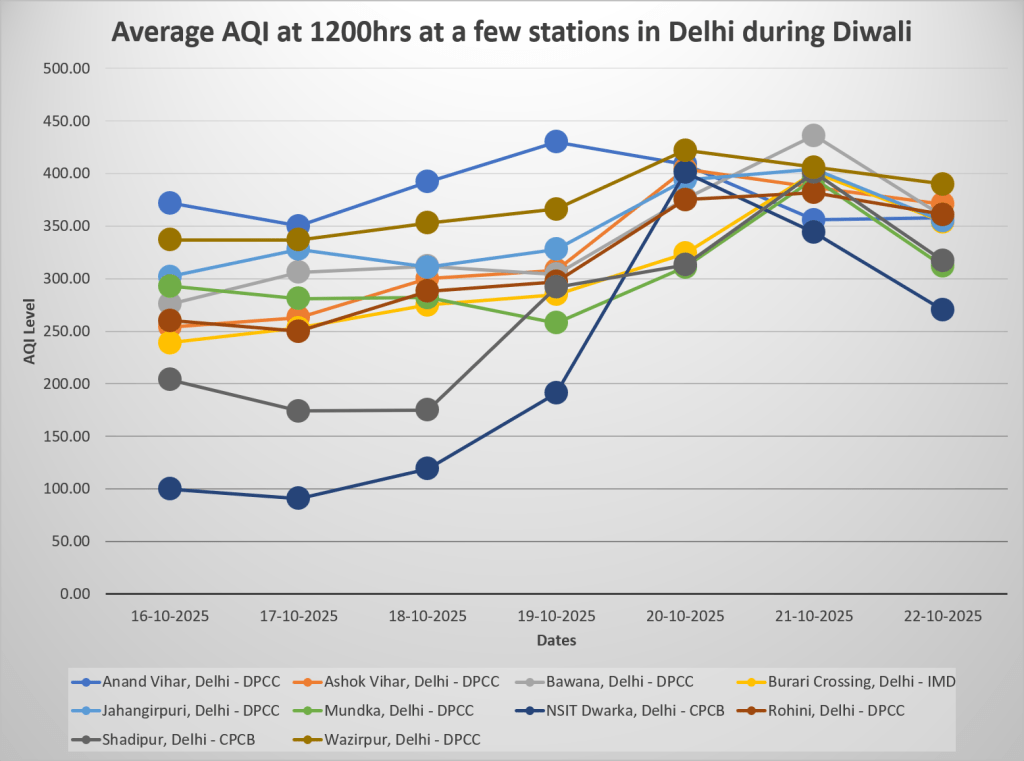
The data shows 24-hour average AQI more than 400 at several stations in Delhi on the Day of Diwali.
According to national standards, these AQI levels range from ‘very poor’ to ‘severe’ with risk of respiratory illness on prolonged exposure and serious impact on those with existing disease.

An AQI of 400 corresponds to PM2.5 levels of >250µg/m³, more than 16 times the recommended 24h average PM2.5 level of 15µg/m³. The WHO recommended annual average of PM2.5 is 5µg/m³.
Source of pollution
- Vehicular emissions, dust from roads & construction activities, and industrial activities are the major contributors of air pollution in Delhi.
- But around Diwali, Firecracker emissions become a major source of air pollution and major contributor of PM2.5 pollutants.
Health implications
- Air pollution is responsible for increase in the cases of acute respiratory illness (ARI). There are increased number of cases with
- Upper respiratory tract infections
- Lower respiratory tract infections including bronchitis and pneumonia
- Exacerbation of asthma, chronic obstructive pulmonary disease (COPD)
- Long term effects include increase in number of cases of Lung cancer
- Hospitalizations, days lost in recovery, and cost of treatment of these illnesses negatively impact the finances of many families, companies, and also the government.
Policy and government response
Measures taken by the Department of Environment, Government of NCT of Delhi to control air pollution is shown in image below.

The GRADED RESPONSE ACTION PLAN (GRAP) for NCR was last revised in September 2024(final_graded_table.pdf). But none of the measures specify prevention of increase in air pollution due to firecracker emissions during Diwali.
The Chief Minister of Delhi tweeted about Diwali wishes, Diwali celebrations with children and the president of India, there were no tweets about the increase in air pollution during Diwali. A tweet from the chief minister of Delhi urged people of Delhi to only burn NEERI approved green crackers on the occasion of Diwali. The Delhi government on 18 October 2025, on the occasion of Dhanteras, organised a grand ‘Deepotsav’ program in which 1.51 lakh diyas were lit.
The CPCB AQI data showed missing reports at several stations on levels of PM2.5 and PM10 for several hours from midnight to morning of 21 October 2025, thereby reducing the average AQI as shown on their site.

The Delhi government is considering artificial rain to reduce air pollution level in Delhi.
The government/MCD resorted to sprinkling water near the monitoring station.
Role of judiciary and legal system
Firecrackers were banned in Delhi NCR region by the Supreme Court in 2018. But this year the court provided a temporary relaxation which allowed burning of firecrackers with restrictions.
- Only green crackers approved by NEERI could be sold and used.
- Sale of crackers was permitted from 18 to 20 October, 2025.
- Use of firecrackers was restricted to two days 19th and 20th October, from 6 – 7 am and 8 – 10 pm.
Public compliance and behavior
The vast population of Delhi NCR region makes it obvious that compliance to the date and time regulations will not be followed, and the same was seen on the day of Diwali.
Opinion
- Though firecracker burning during Diwali led to increase in pollution levels for a few days, the air pollution level in Delhi has been at hazardous level with very poor or severe AQI since several years.
- Ban on crackers will only have a minor effect on the air pollution level and health of residents in Delhi.
- People have to be more aware of the deleterious effects of air pollution and take precautions at individual level to prevent air pollution and respiratory illnesses.
- The actions being taken by government is not enough to keep the air pollution level down in Delhi NCR region. Probably, they require stricter implementation of the policies and formulation of new policies or measures.
 Critic-lens
Leave a comment